Kimetarx, W. Ch. (2020).
“In Western architecture, there has been a human assumption that it is desirable to establish a moral relationship between the interior and the exterior of a building, where the exterior reveals something about the interior, which in turn affirms this relationship.”
—Rem Koolhaas, Delirious New York: A Retroactive Manifesto for Manhattan
To understand the moral relationship to which Rem Koolhaas refers, we must first consider ethics. In general, ethics concerns norms of value: what is good or bad, right or wrong (Son Ki-tae, Silent Storm: Spinoza, p. 86). Moral norms usually take the form of principles that encourage ethical conduct. A moral subject experiences guilt when failing to comply with such principles. Ethical conduct, therefore, may be undertaken either to alleviate existing guilt or to prevent its emergence. Guilt functions as an internal motive for ethical behavior.
Guilt arises when one’s actions conflict with conscience. Whether conscience is grounded in divine command or rational judgment, it may be understood as an entity or mechanism through which transcendental imperatives are perceived. In this sense, conscience is the internalization of transcendence, while guilt is its psychological manifestation.
Because ethics emerges through the individual internalization of the transcendent, it remains fundamentally humanistic. Koolhaas’s claim that the establishment of a moral relation between interior and exterior carries a human-centered character is therefore persuasive. This consideration of personal ethics can be extended to architecture.
The architectural tendency identified by Koolhaas is especially visible in modern rationalist architecture. The modernist proposition that “the façade is the translation of the plan” clearly expresses the belief that a building’s exterior reveals—or ought to reveal—its interior. This resembles the idea that an individual’s ethical behavior should faithfully express conscience. From this perspective, the exterior of a building corresponds to ethical behavior, while its interior corresponds to conscience. Between the two, there must be an architectural equivalent of guilt.
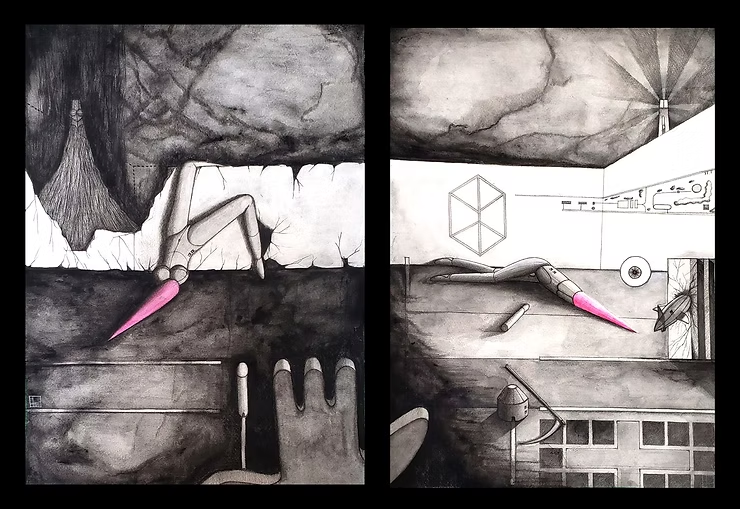
The statement that “ethical behavior is the manifestation of conscience” tends to conceal the negative affect of guilt. In its place, it foregrounds a sense of accomplishment produced by conscience made visible. Likewise, when a building’s exterior reveals its interior, it conceals that which is “affirmed by the interior.” What comes to the fore instead is an apparent purity or transparency: the interior rendered visible as exterior.
Yet this concealed process of affirmation is precisely where guilt finds its architectural manifestation. What, then, corresponds to the architectural interior—that which functions as conscience in ethics? The answer varies according to historical period and cultural context. In ancient Roman architecture, it may be the genius loci, the spirit of place. In medieval European architecture, it may be divine grace. In modern rationalist architecture, it may be reason or rationality.
The exterior of rationalist architecture becomes a white surface, as in Le Corbusier, or a transparent envelope, as in Mies van der Rohe, in order to reveal this rationality. Rationality is reproduced in the plan as an internal order and in the façade as an external order. Yet the relation between plan and façade cannot be established solely through two-dimensional representation. It must be mediated through architecture’s irreducibly three-dimensional condition: space.
Functional rationality thus finds its proper place through space. Space projects this rationality outward, making it vivid, legible, and apparently transparent upon the façade. In this sense, what Koolhaas describes as the exterior’s affirmation of the interior is fundamentally spatial. Space is therefore not merely the interval between interior and exterior; it is the mediating operation through which interiorized rationality becomes visible and morally legible.
Finally, space may be understood as corresponding to guilt itself: the unstable yet necessary medium through which conscience is externalized as ethical behavior, and through which the interior is externalized as architecture. Space, then, is the architectural manifestation of guilt.